
Why make time for yourself?
It seems that cliches often contain a grain of truth.
Whilst it’s easy to see why someone residing in a glasshouse should refrain from hurling stones, how much truth is there in adages about investment? Is there any value in the saying; ‘it’s not about timing the market but time in the market’?
Looking back at how markets performed over time does offer some insights, and one or two surprises. Before we dive in, it is important to say that the past is not a guide to the future. Investing will always mean taking a risk with your money, as the value of equities fall as well as rise. As 3.9m people now have Stocks and Shares ISAs, that raises the question, what is it that convinces people that investing is a risk they are willing to take?
The answer may well be the potential of ‘time in the market’. Here we break down what that means with these three graphs (actually, one graph and two tables).
1. Going for growth
When there is talk of ‘the markets’, in truth, there are many around the globe. It is useful to look at the U.S. as it has data stretching back to the 1870s plus U.S. companies make up approximately 60% of global stock markets. This does not mean that self-investors hold a similar percentage of these stocks in their portfolios, just that as a large data set over a long timeframe, it reveals many ups and downs over the decades.
With so much volatility clearly in evidence over time, why do people put their hard-earned cash into equites? Primarily, because of the potential to realise higher returns when compared to returns on cash savings.
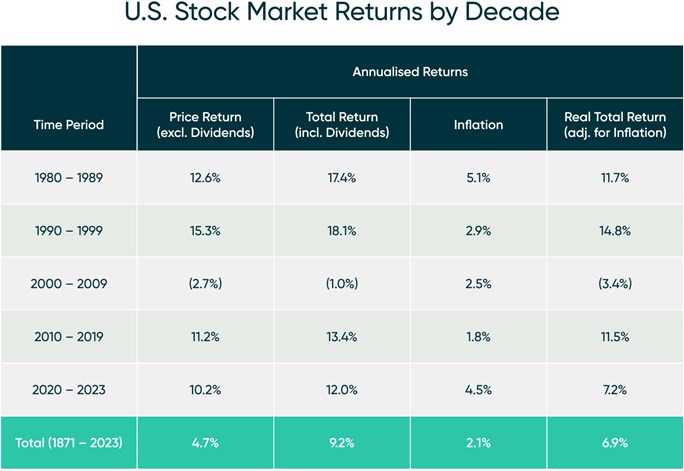
(The ‘U.S. stock market’ draws on data from the S&P Composite index from 1871 to 1957, and the S&P 500 index from 1957 onwards, as collected by Professor Robert J. Shiller)
Three things stand out:
- Investors who kept dividends invested, rather than withdrawing them, enjoyed higher overall returns.
- Global financial crises hit stocks hard. The ‘lost’ decade following the 2007 – 2008 financial crash, saw all major stock markets lose around 20% of their value. By 2009, the Dow (a market index made up of 30 prominent companies listed on stock exchanges in the US) tumbled by 54% and it took four years before it recovered.
- If the decades from 1871 were annualised, equities outpaced inflation, returning an average of 6.9%.
One point to consider:
Volatility is a certainty. Seasoned investors factor in market downturns and keep investments for five years or longer.
2. Take the long view
No doubt investors everywhere held their breath in the late 2000s. So, how significant was the financial crash of 2007 – 2008? In short, it was one of the worst on record.
In October 2008, the stock market dropped by 16.9%. Only one other month saw greater losses - November 1929, which saw a decline of 26.5% during the Great Depression.
Using the lens of US stock market annualised returns once more, rolling periods of one, five, 10 and 20 years, and a different picture emerges.
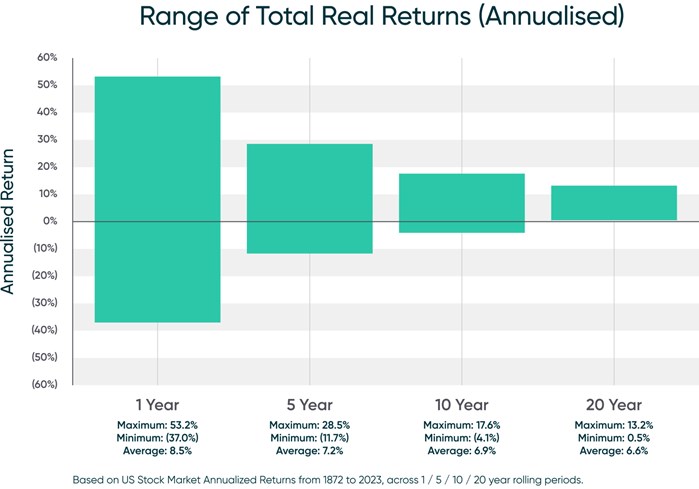
Three things stand out:
- Over twelve-month periods, investors would have been subject to huge variations, from negative 37.0% loss to a positive 53.2% gain.
- Across 20-year periods, the range in returns was narrower, a positive of 0.5% to one of 13.2%
- Taking the average of 20-year periods, stocks returned an average of 6.6%
One point to consider:
Leaving your money invested for less than a 5-year period will always represent a risk, supporting the adage ‘time in the market’ over a short-term attempt at ‘timing the market’.
3. A risk to reward
Cash savings, which you can access instantly, are always good to have but even the most diligent savers need to factor in the impact of inflation.
Essentially, inflation erodes the value of cash, and it does so year after year. So, what does the US data reveal about stock market returns compared to inflation over time?
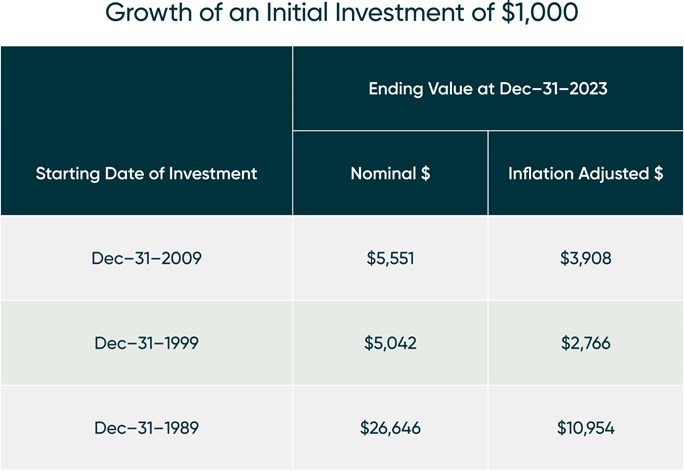
Three things stand out:
- Investors who chose the last day of 1989 to buy into the stock market will have seen impressive growth to over $26,600. Yet when adjusted for inflation, the ‘real’ return is reduced to less than $11,000.
- If $1,000 had been invested in the US stock market at the beginning of different decades (without buying or selling) it will have outpaced cash returns and inflation.
- The longer investors stayed in the market, the better placed they were to accumulate growth.
One point to consider:
When we consider ‘time’ it is essential to also factor in inflation. It is a hidden risk and if the return on cash savings does not outpace the rate of inflation, it will shrink the value of your savings.
Final thoughts
Looking back, it seems that real risk to money comes from acting too slow and too fast.
Too slow because inflation is a steady destroyer and relying on cash savings alone risks a slow erosion of spending power.
Too fast because being too ‘active’ and trying to second guess if a stock will rise or fall over short periods of time leaves investors open to volatility. After all, although the stock market grew in 69% of all the years on record, it declined in 31% of them.
The data reveals that investors focused on patient accumulation, leaving their dividends invested, fared best. Which is why ‘‘it’s not about timing the market but time in the market’ became a truism. Or as the legendary investor Warren Buffett summed it up: “The stock market is designed to transfer money from the Active to the Patient."
The value of investments can fall as well as rise and any income from them is not guaranteed and you may get back less that you invested. Past performance is not a guide to future performance. EQi® is a trading name of Equiniti Financial Services Limited (EFSL). EFSL does not provide investment advice. If you are in any doubt as to the risk of suitability of an investment or product you should seek advice from an independent financial adviser.
